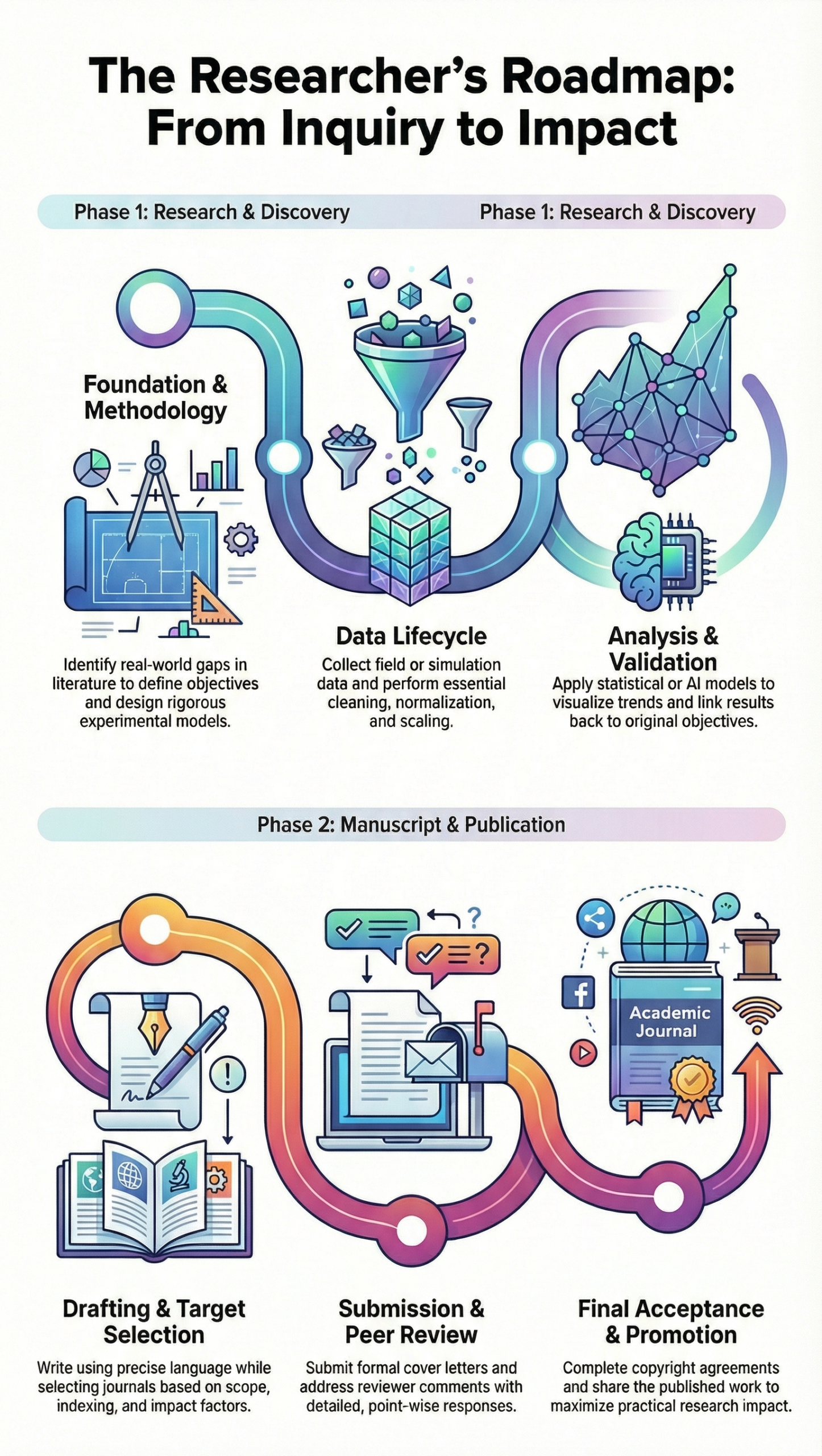
This comprehensive infographic serves as a meticulous step-by-step roadmap aimed at guiding researchers through the complete journey of transforming an initial research idea into a published article in a scholarly journal.
The process begins with problem identification, where researchers pinpoint a specific issue or question that warrants exploration. This is followed by a literature review, where existing research is analyzed to understand the current landscape and identify gaps in knowledge that the new study can address.
Next, the focus shifts to methodology design, in which researchers outline the framework for how they will conduct their study. This section includes selecting appropriate research methods, tools, and frameworks that suit the nature of the inquiry. Once the methodology is established, the next phase involves data collection, where researchers gather the necessary information through various means such as surveys, experiments, interviews, or observational studies.
After obtaining the data, researchers move to the analysis stage, where they systematically examine and interpret the collected data using statistical or qualitative methods. This section is critical for deriving meaningful insights and formulating conclusions based on the evidence gathered.
The next part of the roadmap involves result interpretation, wherein researchers articulate the implications of their findings, discuss the significance of the results, and consider how they relate to the previously reviewed literature.
Once the data analysis and interpretation are complete, the focus shifts to manuscript writing, where researchers must effectively communicate their research narrative, structure their manuscript according to journal guidelines, and ensure clarity and coherence in their presentation. This step often involves multiple drafts and revisions.
After drafting the manuscript, researchers must carefully select an appropriate journal for submission, taking into consideration the journal’s scope, audience, impact factor, and submission guidelines. Following this, the manuscript enters the peer review process, where other experts evaluate the quality and validity of the study. Based on feedback from reviewers, researchers may need to engage in revision, making necessary adjustments to fortify their work before resubmission.
Tailored for students, early-career researchers, and academicians, this visual guide simplifies the often-complex research journey, helping to mitigate common pitfalls and enhance the efficiency of the research process. It serves as an invaluable quick reference for planning, executing, and successfully publishing research work in a structured, systematic manner.