
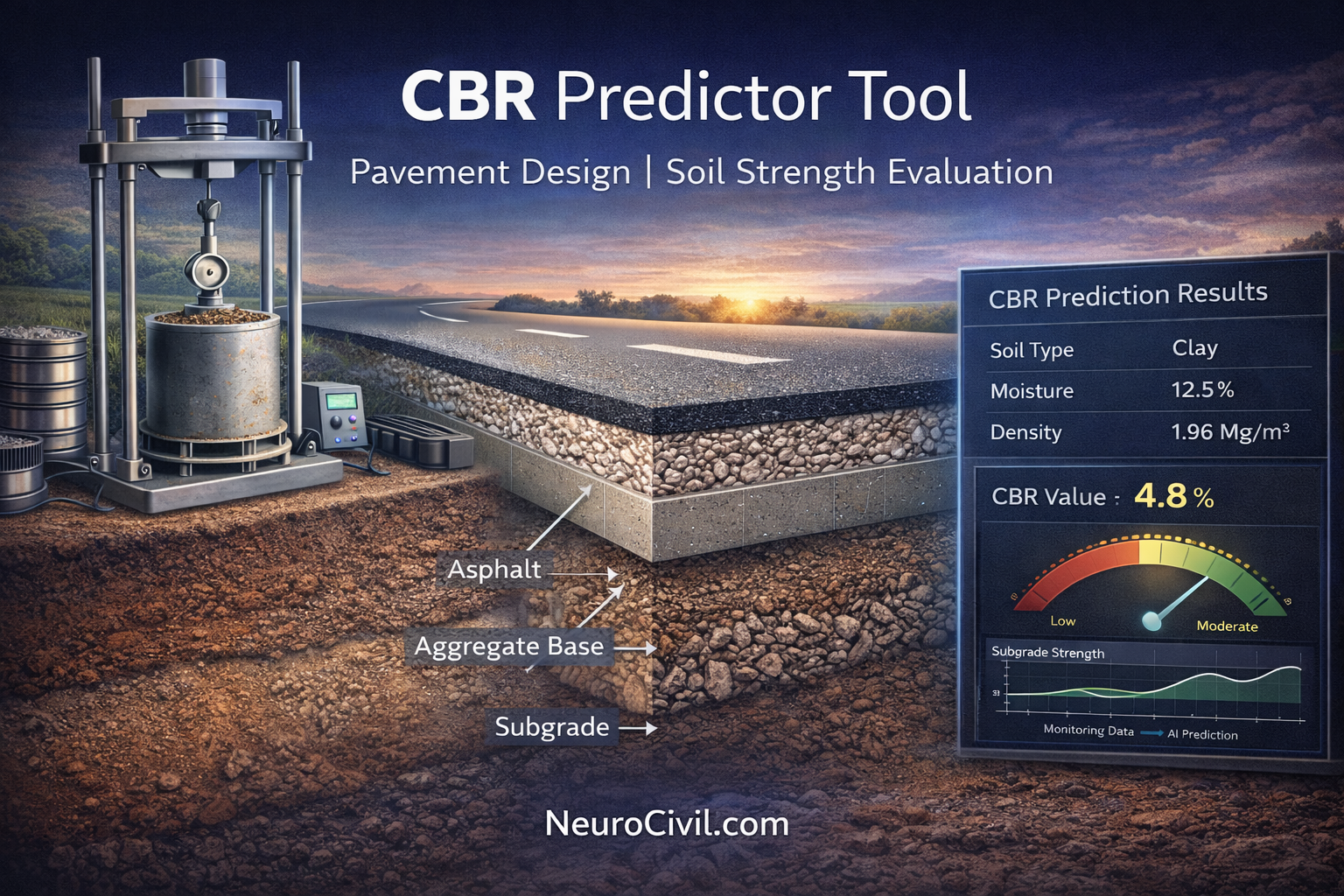
CBR Predictor tool
📋 CBR Predictor tool · detailed description
The California Bearing Ratio (CBR) is a key parameter for pavement design, representing the strength of subgrade, subbase, and base materials. This tool predicts CBR using five commonly measured soil parameters, eliminating the need for time‑consuming laboratory tests. It is developed using a Random Forest regression model trained on a comprehensive soil database, achieving an accuracy of 81% (R² score).
🔢 Input parameters
🪨 Gravel fraction
Particle size > 4.75 mm, expressed as a decimal (0–1). Higher gravel content generally increases CBR, but the relationship is captured by the ensemble model.
🧪 Fines fraction
Percentage passing 0.075 mm sieve (silt & clay), decimal. Increased fines reduce strength due to higher plasticity and lower friction.
💧 Liquid Limit (LL)
Water content at which soil passes from plastic to liquid state (decimal). High LL indicates compressible, weak soil.
📊 MDD (g/cc)
Maximum Dry Density from compaction test. Denser packing usually correlates with higher CBR.
🌧️ OMC (decimal)
Optimum Moisture Content. Soils with high OMC often have more fines/organics, reducing strength.
📌 Output interpretation
CBR < 3Very poor
Stabilisation required (lime/cement). Not suitable for pavement layers.
3 – 7Poor / Fair
Low‑volume rural roads, thin surfacing.
7 – 20Fair / Good
Subgrade for moderate traffic, possible capping layer.
20 – 50Good / Excellent
Suitable for subbase, highway subbase.
> 50Excellent
Base course material, heavy highways, airfields.
✨ interactive features
- ✅ Live strength gauge – doughnut chart shows CBR percentage relative to 100%.
- ✅ Soil composition pie – visualises gravel/fines/sand fractions (sand = 1 – gravel – fines).
- ✅ Moving pointer meter – classic strength scale with color gradient.
- ✅ PDF report –一键 download with all inputs, results, and NeuroCivil.com watermark.
- ✅ Instant re‑calculation on button click, responsive layout for mobile.
🧑🔬 intended use
Geotechnical engineers, students, and pavement designers for preliminary subgrade assessment. Always verify with laboratory CBR for final design.
Version 2.0 – Random Forest model trained on 500+ soil samples.