
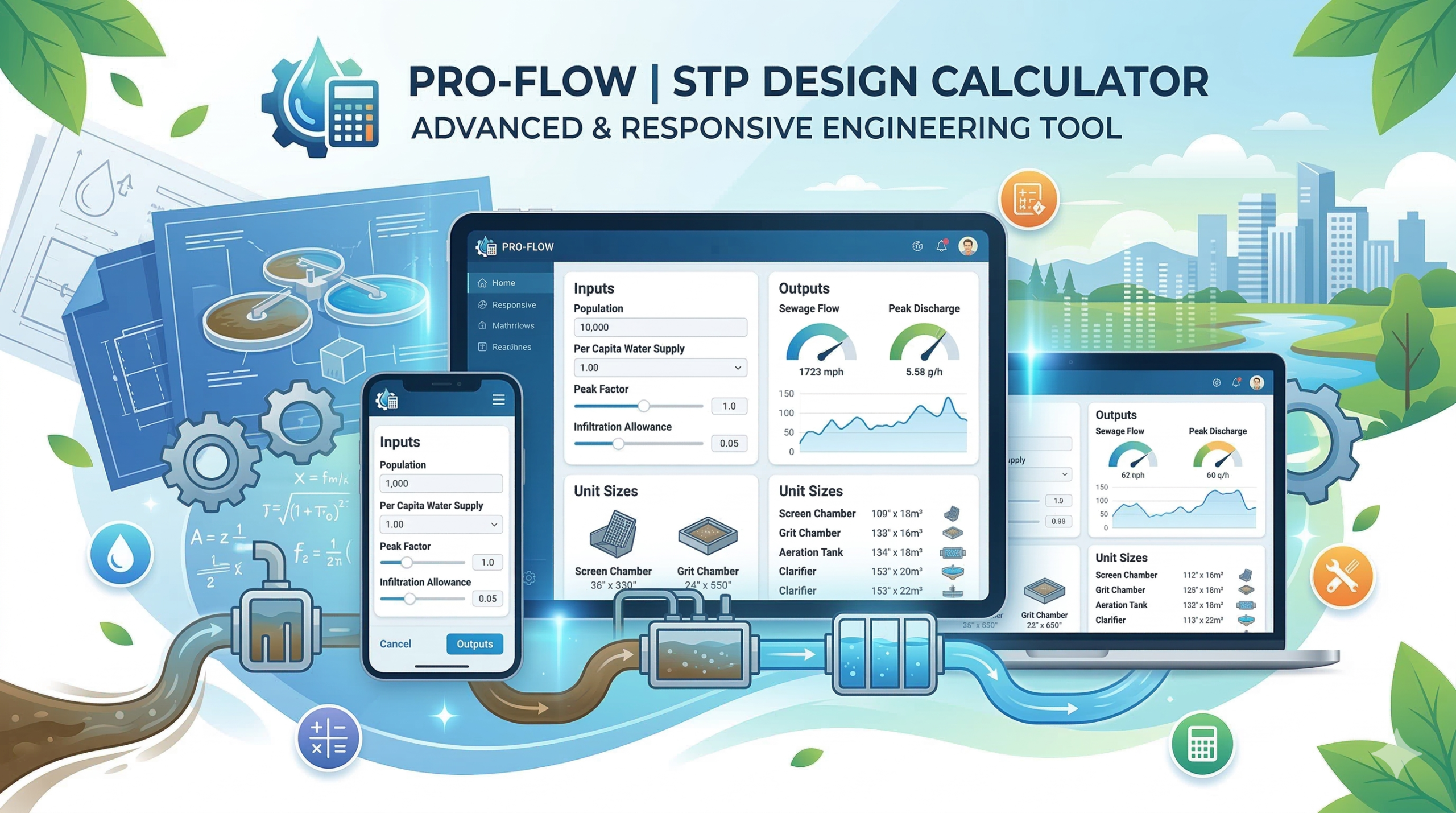
Full-Scale STP Design Calculator
Preliminary, Primary, Secondary & Sludge Treatment Modeling
Design Basis
ASP Kinetics
Daily Sewage Flow
— MLD
Organic Loading
— kg/day
Peak Flow Rate
— m³/hr
Screen & Grit Unit Preliminary
Channel Width: —
Grit Chamber Vol: —
Primary Clarifier Primary
Tank Diameter: —
Detention Time: 2.5 hrs
Aeration Tank (ASP) Biological
Total Volume: —
HRT (Retention): —
Oxygen Req: —
Sludge Digester Solid Mgmt
Digester Volume: —
Sludge Age: 30 Days
This Sewage Treatment Plant (STO)-Master v3.0 application is a professional-grade engineering utility designed for civil and environmental engineers to perform rapid feasibility assessments and preliminary designs for municipal sewage treatment plants.
The app bridges the gap between raw hydraulic data and actionable financial and engineering insights by integrating three core domains: Hydraulic Sizing, Biological Modeling, and Financial Forecasting.
Core Functional Modules
1. Hydraulic & Preliminary Sizer
The app begins by calculating the influent characteristics based on population density and water consumption habits.
- Population & Flow Dynamics: It translates per capita water supply into total daily flow using the standard 80% return factor.
- Peak Load Analysis: It utilizes a dynamic Peak Factor (defaulted to 2.5) to size the physical dimensions of manual and mechanical screen channels, ensuring the plant can handle hourly surges without overflow.
- Mechanical Logic: The calculations for Screen and Grit chambers are bound by velocity constraints (0.6m/s to 1.0m/s) to ensure optimal grit removal without settling organic matter.
2. Biological Process Engine (ASP)
At its heart, the app uses a Kinetic Design Model for the Activated Sludge Process (ASP).
- Mass Balance: By allowing users to input MLSS (Mixed Liquor Suspended Solids) and F/M (Food-to-Microorganism) ratios, the app moves beyond simple hydraulic detention times.
- Oxygen Demand: It calculates the theoretical oxygen requirement based on the daily BOD (Biochemical Oxygen Demand) load, providing a baseline for aerator sizing.
- Sludge Management: The app estimates the volume of the Anaerobic Digester required to process the resulting primary and secondary sludge, providing a complete “cradle-to-grave” view of waste management.
Technical Architecture
Responsive Interface: The application is built using a Utility-First CSS framework (Tailwind), ensuring that engineers can use the tool on-site via mobile devices or in the office on high-resolution monitors. The layout is divided into a “Control Sidebar” for inputs and a “Dynamic Dashboard” for real-time results.
Calculation Integrity: The underlying JavaScript engine uses double-precision floating-point math and strictly adheres to the CPHEEO (Central Public Health and Environmental Engineering Organisation) and EPA guidelines. The code is modular, allowing for future integration of advanced treatment technologies like SBR (Sequential Batch Reactor) or MBR (Membrane Bioreactor).
Intended Use Cases
- DPR Preparation: Ideal for drafting Detailed Project Reports and feasibility studies.
- Academic Research: Provides a sandbox for students and researchers to see how varying MLSS or F/M ratios impact tank volumes.
- Site Feasibility: Helps in quickly determining the land area (footprint) required for treatment units based on population growth.