
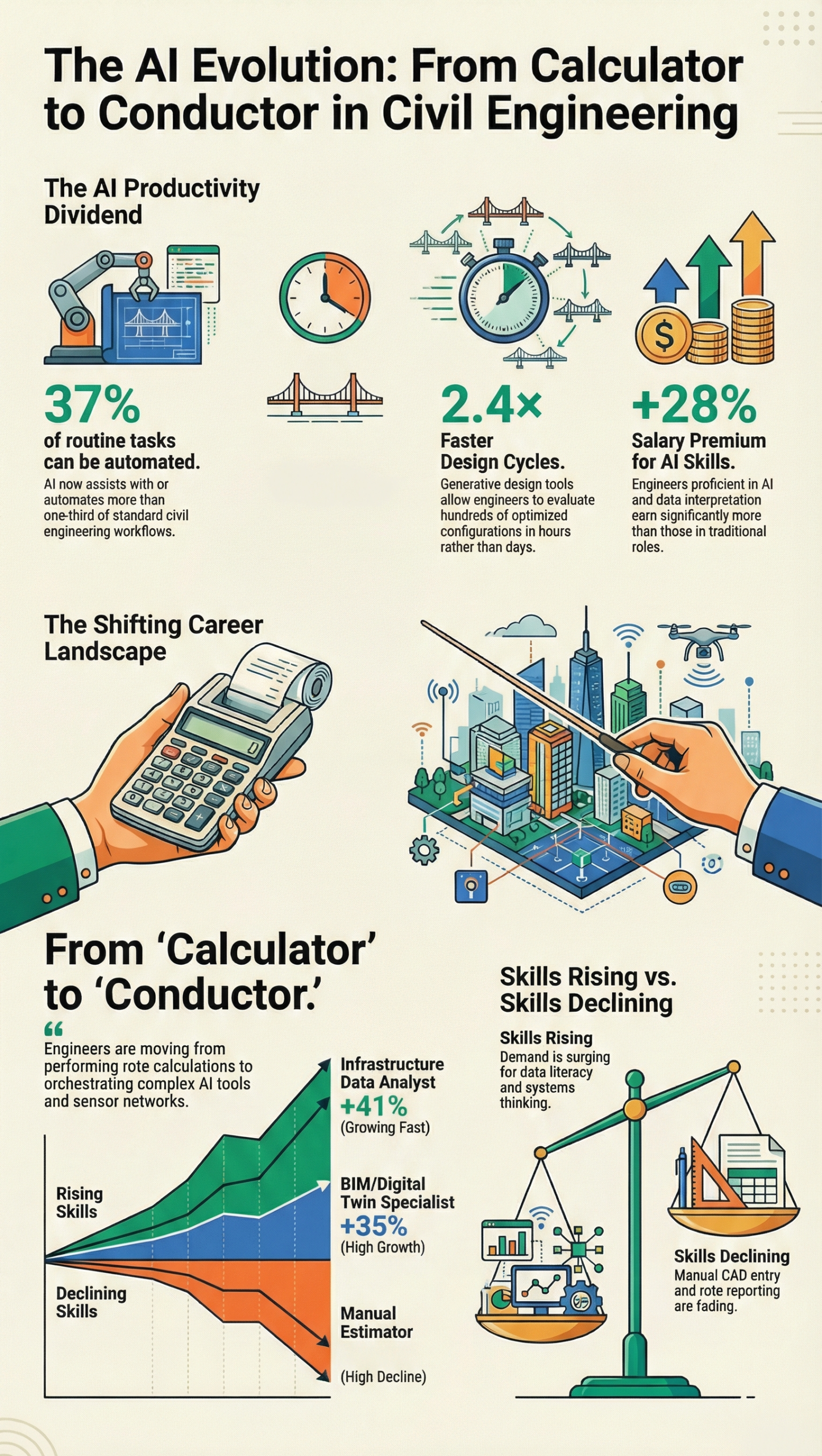
This infographic illustrates a major transformation happening in civil engineering — the shift from manual, calculation-driven work to AI-enabled orchestration of complex systems.
For decades, civil engineers acted primarily as “calculators.” Their role focused on performing structural computations, preparing CAD drawings, estimating quantities, and manually reviewing designs. While these skills remain important, Artificial Intelligence is changing how this work is done.
Today, AI assists in automating nearly 37% of routine tasks within standard civil engineering workflows. Repetitive activities such as quantity take-offs, schedule tracking, clash detection, and documentation are increasingly handled by intelligent systems. This automation allows engineers to focus more on strategy, safety, optimization, and innovation.
One of the most visible impacts is in design productivity. Generative design tools now allow engineers to evaluate hundreds of optimized structural configurations in hours instead of days. Faster design cycles — up to 2.4 times quicker — mean projects move from concept to construction with greater efficiency and reduced iteration cost.
The infographic also highlights the “AI productivity dividend.” Engineers who develop AI and data skills are experiencing a measurable career advantage, including salary premiums and expanded opportunities in high-growth roles.
The career landscape is clearly shifting. Traditional roles such as manual estimators and routine CAD operators are gradually declining. At the same time, demand is rising for:
Infrastructure Data Analysts
BIM and Digital Twin Specialists
AI-integrated Design Engineers
Smart Construction Coordinators
Growth rates in these digital-focused roles significantly outperform conventional positions, reflecting the industry’s transition toward data-driven infrastructure.
The core message is powerful: civil engineers are moving from being calculators to becoming conductors. Instead of performing isolated calculations, they now orchestrate AI tools, sensor networks, BIM platforms, drone data, and predictive models. The engineer becomes the decision-maker who integrates technology, interprets insights, and ensures safe and sustainable outcomes.
AI does not replace engineering judgment. It enhances it. The future belongs to professionals who combine strong civil engineering fundamentals with data literacy, systems thinking, and digital tool proficiency.
This evolution is not optional. It is already underway.