
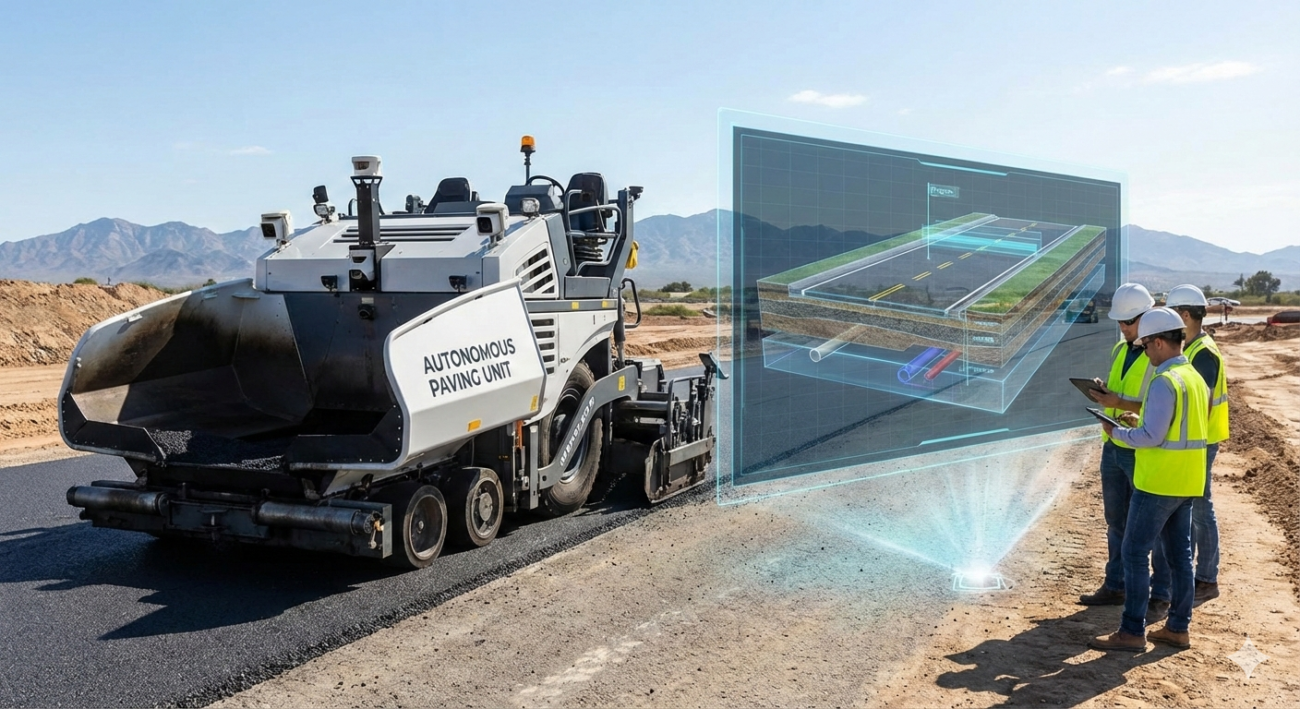
What is an autonomous paver?
An autonomous paver is a road paving machine that can follow a digital design model and automatically control its position, direction, paving height, slope, and often screed width, with minimal operator input. Instead of relying on string lines and manual grade checks, the machine “reads” a 2D or 3D design and adjusts its hydraulics and screed in real time to match the target surface.
In practice, most machines on jobsites today are semi‑autonomous pavers, where the system handles steering, grade, slope, and width while an operator supervises and manages material flow. Fully autonomous trials, where the paver runs without an operator on the platform, are starting to appear in research projects and controlled highway sections.
Core technologies in autonomous asphalt pavers
Autonomous asphalt pavers combine several technologies that together create an “intelligent paving” system.
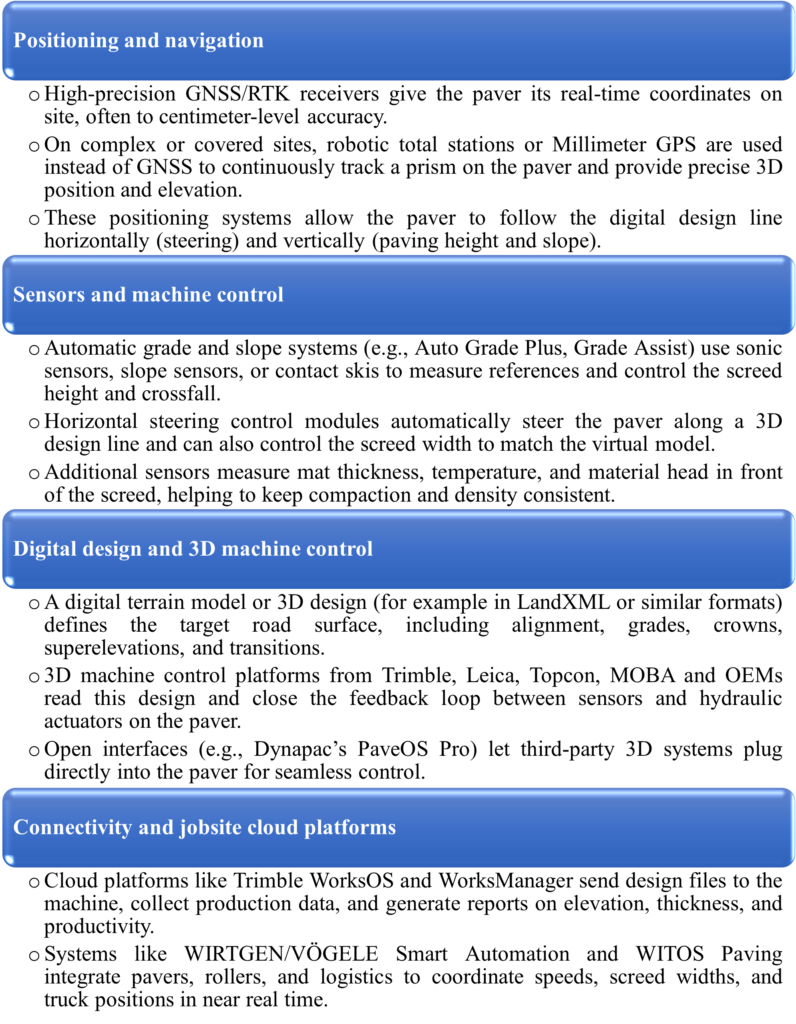
These elements together make autonomous asphalt paving and smart road construction possible.
How autonomous asphalt pavers work on site
- Design and setup
Before construction, the design team prepares a detailed 3D road model with centerlines, lane edges, elevation profiles, crowns, and cross slopes. This model is checked, optimized for constructability, and then exported to the 3D paving control systems used on site.

On site, surveyors set up GNSS base stations or robotic total stations and establish control points that tie the digital model to real ground coordinates. The design files are then transferred to the paver’s control platform, via USB, Wi‑Fi, or cellular connection through platforms like WorksManager or similar OEM data portals.
- Calibration and reference definition
The paver is calibrated so that screed sensors, grade sensors, and positioning systems all reference the same coordinate frame and height datum. Operators define key parameters such as mat thickness, target cross slope, and starting position along the alignment; in systems like Auto Grade Plus and Grade Assist, these target profiles are stored and used to automatically control grade and slope over the length of the section.
In some setups, virtual references completely replace physical string lines: VÖGELE Smart Pave, for instance, uses virtual references to control paver direction and screed width based on the 3D design instead of fixed guide wires.
- Autonomous paving run
During paving, sensors and controllers run in a continuous feedback loop:
- The GNSS/RTK receiver or total station gives the machine its exact position and elevation multiple times per second.
- The control platform compares this to the target 3D design and computes required corrections to steering, screed height, slope, and width.
- Hydraulic actuators and steering systems then apply these corrections automatically, keeping the paver exactly on line and level while maintaining the planned pavement thickness.
Modern systems like Trimble Roadworks Horizontal Steering Control can automatically steer compatible VÖGELE pavers and adjust screed width according to the 3D design, dramatically reducing the operator’s manual workload. Dynapac’s highway pavers, combined with Leica, Trimble, or Topcon 3D control and PaveOS Pro, similarly navigate and adapt autonomously across the jobsite in real time.
Meanwhile, logistics and compaction are coordinated through connected platforms: WITOS Paving and similar systems share live information on pave speed, screed width, truck positions, and temperature maps so paver and rollers act as a semi‑autonomous ecosystem.
Levels of automation in paving
Autonomous pavers span a spectrum from assistive 2D systems to fully autonomous machines, and understanding these levels of automation is useful for contractors and engineers.
- 2D automatic grade and slope control
- Sonic sensors and slope sensors maintain a constant thickness and cross slope relative to a string line, curb, or averaging ski.
- These systems reduce manual crank adjustments but still require the operator to steer and manage width.
- 3D machine guidance (operator still drives)
- GNSS or total stations display recommended steering and screed adjustments on a screen; the operator follows visual or audio guidance.
- The system helps keep the paver closer to the 3D design but does not fully close the control loop.
- 3D machine control / semi‑autonomous paving
- The control platform directly commands steering and screed hydraulics, keeping grade, slope, direction, and often width on target automatically.
- Examples include Trimble Roadworks with Horizontal Steering Control and screed width control, and VÖGELE Smart Pave / AutoTrac systems.
- Fully autonomous pavers (research and pilot stage)
- In InfraROB’s A9 motorway trial in Austria, a fully autonomous paver laid a 180 m section of asphalt without direct operator control on the platform, with staff supervising from a safe distance.
- These systems combine advanced sensor fusion, path planning, obstacle detection, and integrated logistics to operate with minimal human intervention.
Most commercial “autonomous pavers” used today fall into level 3, where the machine handles routine control tasks and the operator acts more like a supervisor and logistics manager.
Benefits of autonomous and semi‑autonomous pavers
Higher paving quality and accuracy
By locking the screed to a 3D design and continuously correcting for deviations, autonomous pavers achieve better surface evenness, profile accuracy, and layer thickness than manual methods. Systems such as Auto Grade Plus and Grade Assist specifically target smoothness and profile accuracy by automatically adjusting grade and slope to eliminate irregularities as they occur. 3D paving control also reduces over‑ or under‑paving, which is critical for meeting specification on high‑speed highways, runways, and test tracks where tight tolerances are enforced.
Productivity and cost savings
Autonomous pavers can work faster because they eliminate many manual tasks such as staking out string lines, repeated manual measurements, and constant steering corrections, while Trimble and Dynapac report that auto steering and screed width control reduce operator fatigue and enable higher paving speeds along with more consistent production. Since material quantities are more accurately matched to the actual design, these systems also reduce asphalt waste and help contractors better predict daily tonnage and truck cycles.
Safety and workforce optimization
Autonomous and semi‑autonomous paving moves workers away from dangerous positions near the screed and trucks, especially where string lines and manual grade checking are no longer needed. In the STRABAG A9 trial, for example, the fully autonomous paver allowed staff to monitor operations from safer zones, reducing exposure to traffic and hot material.
Connected ecosystems like WITOS Paving and RoadScan provide live temperature, speed, and position data to foremen and roller operators, helping them coordinate without constant radio calls and reducing the risk of miscommunication‑related incidents.
Sustainability and resource efficiency
Autonomous pavers help cut fuel use and emissions by minimizing rework, optimizing machine passes, and reducing waiting time for trucks and rollers. More accurate layer thickness and smoother surfaces also extend pavement life, lowering the long‑term environmental footprint of a road network.
Real‑world examples of autonomous pavers
- On the A9 motorway near Graz in Austria, contractor STRABAG and partners in the EU InfraROB project tested a fully autonomous asphalt paver on a 180 m trial section during live renovation works. The automatic control system, developed together with TPA and German research partners, controlled the paver without an operator at the controls, using advanced measurement and sensor technology originally developed in the Robot – Road Construction 4.0 project. Human staff stayed on site to oversee logistics, material delivery, and safety, but the paving itself handled various operations automatically such as direction, speed, and screed control, demonstrating how fully autonomous paving can improve safety and process stability.
- Dynapac’s SD and XD generations of highway pavers show how autonomous paving is already entering everyday work under the banner of “Road Construction 4.0.” These pavers are designed to integrate seamlessly with 3D machine control systems from Leica, Trimble, and Topcon via a bi‑directional open interface to Dynapac’s PaveOS Pro software, allowing true 3D navigation where height, slope, direction, and screed width are all coordinated automatically as the machine moves across the jobsite. Many tenders in advanced markets now explicitly ask for such autonomous or highly automated paving capabilities, indicating that these systems are no longer experimental add‑ons but features expected on major highway projects.
- In Bellinzona, Switzerland, Leica Geosystems presented a case study where multiple asphalt pavers were equipped with 3D machine control and coordinated via total stations during a complex road renovation project. The pavers followed the digital model with high precision, and the system synchronized their movements and screed settings, allowing the contractor to overcome spatial constraints and safety challenges while significantly accelerating the construction schedule. This example highlights how even when machines are not fully autonomous, 3D control and digital coordination can function like an “autonomous team,” minimizing overlap, cold joints, and inconsistencies between lanes.
- Trimble’s Roadworks Paving Control Platform version 2.10 is another step towards autonomy, especially on VÖGELE Navitronic asphalt pavers. In this configuration, the system automatically steers the paver and controls screed width according to a 3D design, delivering higher quality and more accurate paving with less operator fatigue than traditional methods. By connecting to cloud tools like WorksOS and WorksManager, the same system also supports remote sharing of design files, productivity reporting, and elevation analysis, helping contractors monitor production and quality from the office in near real time.
- The WIRTGEN Group’s Smart Automation in Roadbuilding and VÖGELE Dash 5 paver generation provide another example of semi‑autonomous paving done at scale. Dash 5 pavers use Auto Grade Plus and Grade Assist to automate grade and slope, while AutoTrac and Smart Pave handle steering and screed width based on physical or virtual references, effectively letting the paver “follow” the 3D model with minimal manual input. At the same time, digital tools like the Work Planner and Smart LEVEL PRO support automated milling and rehabilitation, creating an integrated, largely autonomous milling‑paving chain from design through to execution.
- Industry articles also document how semi‑autonomous paving ecosystems combine pavers, rollers, and material trucks. For example, WITOS Paving integrates RoadScan thermal imaging, a smartphone app, and paver telemetry to visualize pave speed, screed width, truck positions, and live temperature maps, so roller operators can plan compaction patterns based on real‑time data rather than guesswork or constant radio calls. AsphaltPro has highlighted similar autonomous concepts, noting how autonomous or remotely supervised material transport vehicles and track loaders can support the paving train, freeing skilled workers to focus on supervision, quality control, and planning instead of repetitive driving tasks.
Conclusion
Although autonomous pavers and smart asphalt paving systems are maturing quickly, several challenges still need attention. Data workflows are a major barrier: creating high‑quality 3D models, validating them, and keeping them synchronized across survey, design, and construction teams requires new skills and reliable digital processes. Many contractors also need training so operators feel comfortable trusting automatic steering and screed control systems such as Smart Pave, Auto Grade Plus, or Roadworks Horizontal Steering, rather than overriding them out of habit.
From a technology and regulatory standpoint, fully autonomous pavers must handle varying traffic conditions, complex work zones, and interactions with other machines and workers, which is more complicated than closed mining sites where autonomy first matured. Research projects like InfraROB are therefore focusing not just on the paver itself, but on modular robotized solutions for barriers, road marking, and patching, aiming to make whole work zones safer and more automated. At the same time, OEMs such as Dynapac, WIRTGEN/VÖGELE, Trimble, Leica, Topcon, MOBA, and others are converging on open interfaces and integrated jobsite clouds so that different brands can share data and function together in one autonomous paving ecosystem.
Reference
- Asphalt paver automation systems for 2D and 3D paving projects. (n.d.). https://www.topconpositioning.com/solutions/infrastructure/asphalt-paving/asphalt-pavers
- Autonomous road paving. (Accessed 2026). World Highways. Retrieved February 22, 2026, from https://www.globalhighways.com/news/autonomous-road-paving
- Bhayani, N. (2025, August 11). 3D paving Solutions – MOBA Mobile Automation India. MOBA Mobile Automation India. https://moba-automation.co.in/products/3d-paving/
- The future has begun: autonomous paving in Real-World road construction. (Accessed 2026). Dynapac – Road Construction Equipment. https://dynapac.com/eu-it/news/the-future-has-begun-autonomous-paving-in-real-world-road-construction
- Trimble introduces horizontal steering control, automatic screed width control for vögele asphalt pavers. (2022, October 25). Trimble Mediaroom. https://news.trimble.com/2022-10-25-Trimble-Introduces-Horizontal-Steering-Control,-Automatic-Screed-Width-Control-for-Vogele-Asphalt-Pavers
- Vögele. (Accessed 2026). The Dash 5 Generation of Pavers – Automation | VÖGELE. https://www.wirtgen-group.com/en-in/products/voegele/-dash-5-generation-of-pavers/process-automation/
- Vögele. (Accessed 2026). The Dash 5 paver generation – automation | VÖGELE. https://www.wirtgen-group.com/en-us/products/voegele/dash-5-paver-generation/process-automation/