
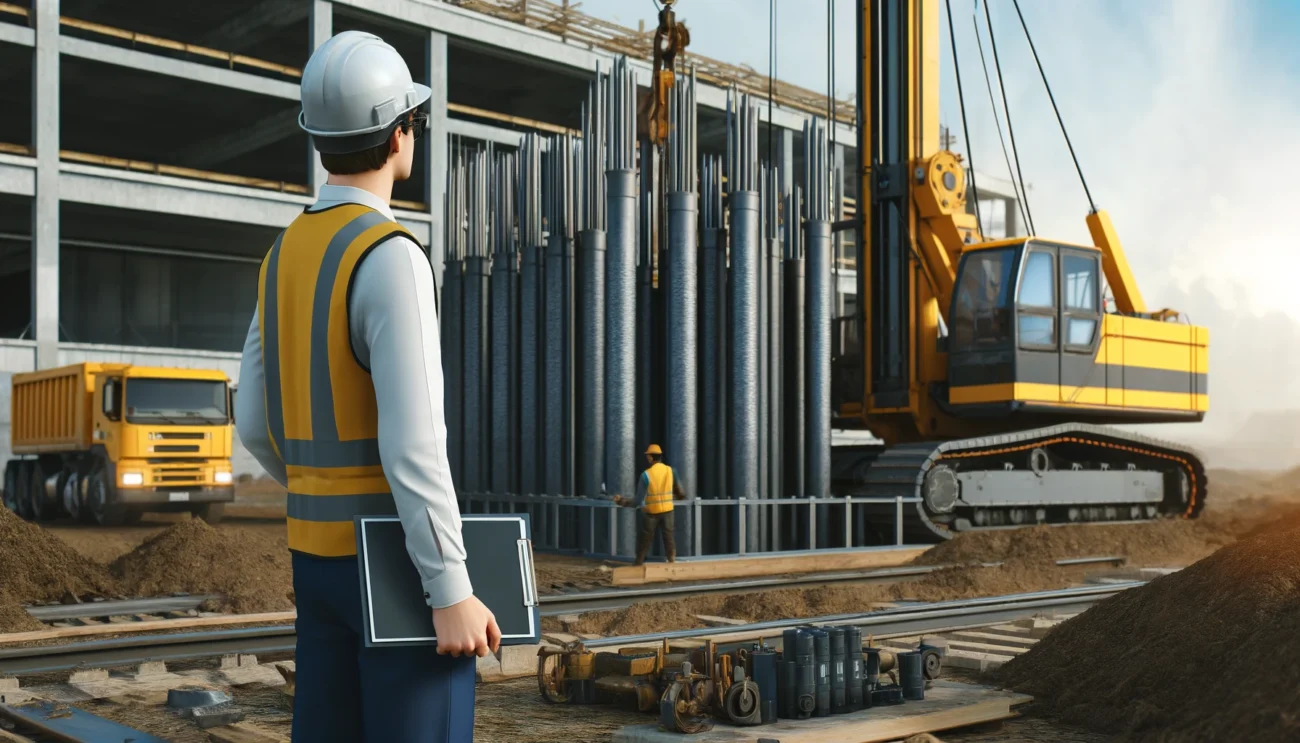
Have you ever wondered how skyscrapers and massive bridges stay firmly in place without sinking into the ground? The secret lies beneath the surface in what engineers call “piles” – deep foundations that transfer the weight of structures into the ground. Today, I’m exploring an exciting advancement in predicting how these piles settle over time, utilizing a sophisticated combination of artificial intelligence techniques.
When constructing a tall building or bridge, the foundation must be rock-solid. Piles are long columns made of concrete, steel, or timber that are driven deep into the ground until they reach stable soil or bedrock. Think of them as the roots of a tree, providing stability to everything above.
However, here’s the challenge, even the best-designed piles will settle somewhat under load. A skyscraper might sink a few millimetres or centimetres as the ground compresses beneath it. While this sounds alarming, controlled, predicted settlement is actually normal and acceptable. What engineers need to avoid is an unexpected or uneven settlement that could compromise the structure’s integrity. For example, the famous Leaning Tower of Pisa wasn’t supposed to lean, it’s the result of a foundation settlement that wasn’t properly predicted. Modern engineering aims to prevent such surprises!
Traditionally, engineers have used either empirical methods (based on past experience) or analytical approaches (mathematical models) to predict pile settlement. But these methods don’t always hit the mark because the interaction between piles and surrounding soil or rock is incredibly complex. As one researcher, Carrubba, noted, while both approaches have merit, neither consistently provides accurate predictions due to the complicated behaviour of piles in diverse ground conditions.
This is where artificial intelligence comes into play. Researchers have developed a hybrid system that combines artificial neural networks (ANNs) with particle swarm optimization (PSO), creating what is called a “neuro-swarm” system.
Let me break this down in simple terms:
- Neural networks are computing systems inspired by the human brain. They’re excellent at finding patterns in complex data but sometimes struggle to find the best solution.
- Particle swarm optimization is inspired by how birds flock or fish school together to find food. It helps the neural network avoid getting stuck in sub-optimal solutions.
Together, they form a powerful prediction tool that learns from existing pile data to forecast how new piles will behave.
When engineers plan to install piles, they need to consider several key factors that influence settlement:
- Pile geometry (diameter, length, cross-sectional area)
- Soil and rock properties
- How much load the pile will bear
- How deep the pile extends into different layers (soil vs. rock)
The neuro-swarm system takes these inputs and processes them through its neural network. But here’s where it gets interesting, the PSO component constantly adjusts the network’s parameters to find the optimal prediction model.
Technically speaking, the PSO works by having “particles” (potential solutions) move through a solution space according to mathematical formulas:
- Each particle’s new velocity depends on its current velocity, its personal best position, and the global best position found by any particle.
- The system balances between exploring new solutions and refining known good ones.
This hybrid approach overcomes the limitations of traditional neural networks, which sometimes get “trapped” in local solutions that aren’t actually the best overall answer.
Imagine you’re an engineer planning the foundation for a new hospital in an area with complex geology with layers of soft soil over bedrock. Using a neuro-swarm model trained on similar projects, you could accurately predict how much each pile will settle under the building’s weight.
The approach outlined offers several practical benefits, including a more efficient design that utilizes the exact number and size of piles needed. This leads to significant cost savings, as there is no longer a need for over-designing to account for uncertainty. Additionally, improved predictions enhance safety by minimizing unexpected issues during construction, resulting in a faster overall process. In densely populated urban areas, where space is limited and the potential impact on nearby structures must be carefully considered, this precision in construction becomes even more invaluable.
The researchers tested their neuro-swarm system against actual pile settlement data and found impressive results. The best model achieved a coefficient of determination (R²) of 0.851 for training data and 0.892 for testing data. In simple terms, this means the model could explain about 85-89% of the variation in pile settlement – quite remarkable for such a complex problem!
System errors were also impressively low at 0.079 and 0.099 for training and testing phases respectively. For context, this means predictions were typically within millimeters of actual settlements.
As we build taller structures in more challenging environments, tools like the neuro-swarm system become increasingly valuable. They allow engineers to push the boundaries of what’s possible while maintaining safety and efficiency.
Imagine the massive foundations needed for tomorrow’s super-tall buildings or offshore wind farms – these projects depend on precise settlement predictions to ensure decades of stable performance.
The best part? As more pile data becomes available and these AI systems continue learning, their predictions will only get better. It’s a perfect example of how combining traditional engineering knowledge with cutting-edge AI can solve complex real-world problems.
In conclusion, the integration of neuro-swarm intelligence into the prediction of pile settlement represents a significant leap forward in civil engineering practices. By harnessing the strengths of both artificial neural networks and particle swarm optimization, this innovative approach not only improves the accuracy of settlement predictions but also enhances the overall safety and efficiency of construction projects. As we look towards the future, the ability to better anticipate how piles will behave under various conditions will empower engineers to design more effective foundations, ultimately leading to safer, more durable structures. This advancement demonstrates that, with the right tools and techniques, we can effectively address the complexities of modern construction challenges, ensuring that skyscrapers and bridges remain stable for generations to come.
Reference
Armaghani, D. J., Asteris, P. G., Fatemi, S. A., Hasanipanah, M., Tarinejad, R., Rashid, A. S. A., & Huynh, V. V. (2020). On the use of neuro-swarm system to forecast the pile settlement. Applied Sciences, 10(6), 1904.https://doi.org/10.3390/app10061904
Soleimanbeigi, A.; Hataf, N. Prediction of settlement of shallow foundations on reinforced soils using neural networks. Geosynth. Int. 2006, 13, 161–170
Chen, W.; Sarir, P.; Bui, X.-N.; Nguyen, H.; Tahir, M.M.; Armaghani, D.J. Neuro-genetic, neuro-imperialism and genetic programing models in predicting ultimate bearing capacity of pile. Eng. Comput. 2019.
Koopialipoor, M.; Armaghani, D.J.; Hedayat, A.; Marto, A.; Gordan, B. Applying various hybrid intelligent systems to evaluate and predict slope stability under static and dynamic conditions. Soft Comput. 2018.