
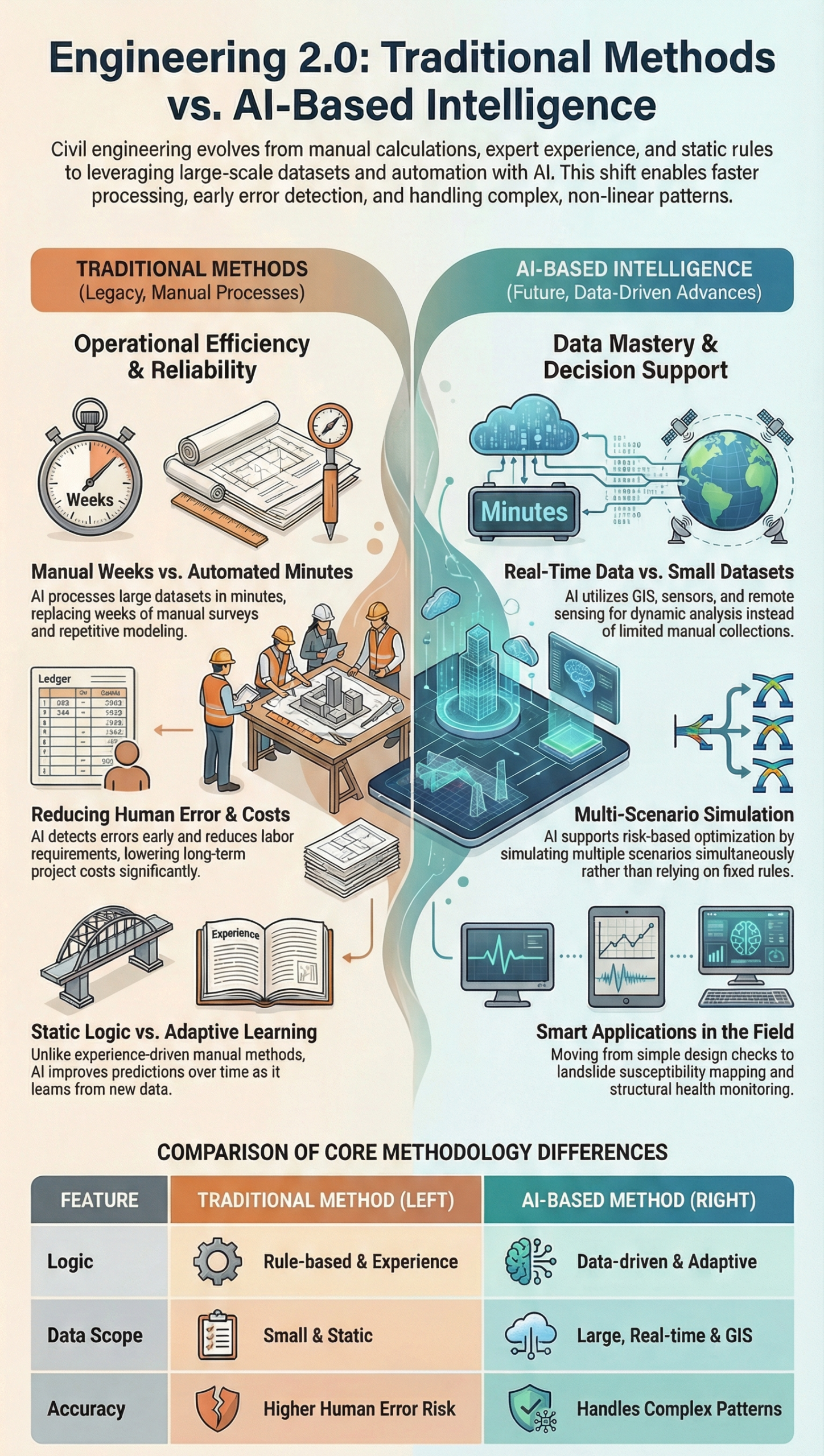
Civil engineering has always relied on traditional methods such as field surveys, empirical formulas, and expert judgment. These approaches have built roads, bridges, dams, and cities for decades. However, modern infrastructure challenges are more complex than ever, as rapid urbanisation, climate change, limited resources, and increasing safety demands now require faster, smarter, and more reliable solutions. This is where AI-based methods are transforming civil engineering practice.
This infograph presents a clear, side-by-side comparison of traditional methods versus AI-based methods in civil engineering, focusing on four critical aspects: time, accuracy, cost, and data requirements. The goal is not to replace traditional engineering wisdom, but to show how artificial intelligence enhances decision-making and project efficiency.
Traditional methods often involve manual calculations, limited datasets, and time-consuming fieldwork. While they are grounded in engineering principles, they struggle to handle large volumes of data and complex, non-linear relationships. As a result, project timelines can extend, costs may rise, and uncertainty remains high in risk-prone applications such as landslide assessment, traffic prediction, and structural monitoring.
In contrast, AI-based methods use machine learning, GIS, remote sensing, and sensor data to analyze patterns that are difficult for humans to detect. These models can process massive datasets in minutes, deliver consistent predictions, and continuously improve as new data becomes available. AI significantly reduces human effort, minimizes errors, and supports scenario-based planning.
Through this comparison, the infograph helps students, researchers, and professionals understand where traditional methods remain essential and where AI adds real value. It also highlights how hybrid approaches—combining engineering knowledge with AI—are shaping the future of civil engineering.